


A disposable cholangioscope is an indispensable core instrument in ERCP surgery, and its design directly affects the success rate of the procedure and the patient's postoperative recovery. The cholangioscope not only needs excellent delivery and maneuverability but also must ensure safety and therapeutic efficacy in complex anatomical environments.
**Multi-lumen design improves efficiency:** The eight-lumen structure allows multiple channels to operate simultaneously, such as contrast agent injection, bile drainage, drug injection, or instrument insertion, avoiding frequent equipment changes and shortening the operation time.
**Flexible steering and precise positioning:** The eight-lumen braided tube can be flexibly adjusted within narrow bile ducts, ensuring that the catheter tip accurately reaches the lesion site, which is especially suitable for patients with complex anatomy.
High pressure resistance and deformation resistance: The braided structure enhances the catheter's pressure resistance, maintaining stability even during high-pressure angiography or dilation procedures, preventing catheter deformation or rupture. Reduced tissue damage: The catheter surface undergoes special treatment to reduce friction, minimize irritation to the biliary mucosa, and lower the risk of postoperative infection and inflammation.
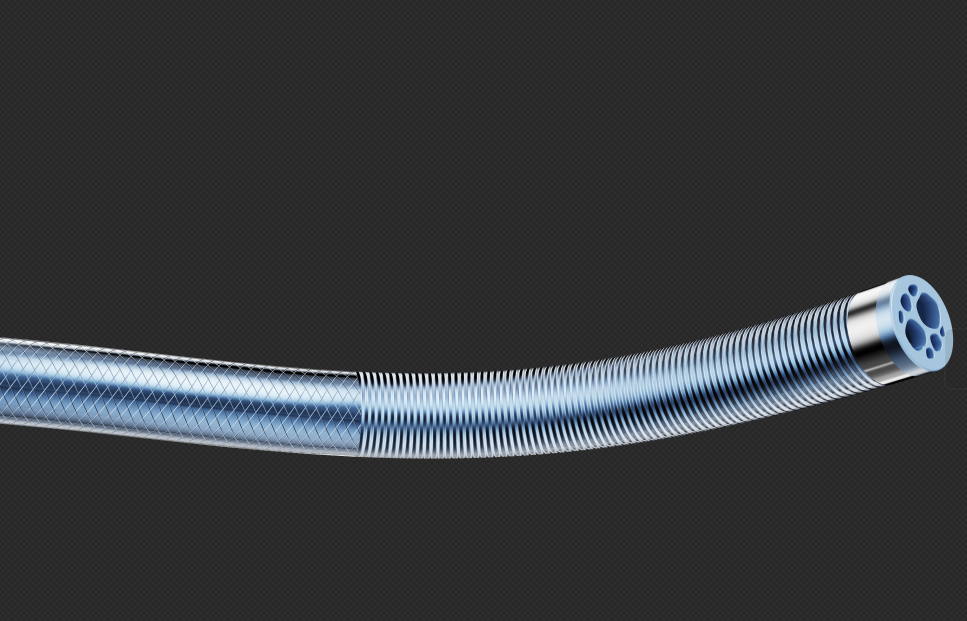
From a technological perspective, the manufacture of eight-lumen braided tube requires advanced material composite technology and precision machining processes. Its catheter adopts a three-layer composite structure, balancing flexibility, strength, and biocompatibility:
Ø Inner Tube: PTFE (polytetrafluoroethylene) etched tube. PTFE is a low-friction, highly corrosion-resistant material widely used in medical devices. The etching process further optimizes the inner tube surface, making it smoother, which not only facilitates instrument delivery but also reduces irritation to bile duct tissue and lowers the risk of postoperative complications. Ø. Middle Layer: Stainless steel braided layer. This layer is precisely woven from high-strength stainless steel wire, enhancing the catheter's tensile and compressive strength while maintaining flexibility. The stainless steel braided layer also provides stable support when the catheter is bent, preventing excessive twisting and ensuring the precision of the physician's operation. Ø. Outer Tube: Made of Pebax material. Pebax is a high-performance medical polymer with excellent softness and toughness, adapting to the natural curvature of the bile duct while providing good tactile feedback and operational feedback. The outer tube surface is also treated with a hydrophilic coating to further reduce friction and improve catheter passage. The eight-lumen braided tube also features four-way adjustable bending. Using the control device on the handle, the physician can flexibly adjust the bending angle of the catheter tip (in four directions: up, down, left, and right) to adapt to different patients' biliary anatomy. This design is particularly suitable for cases with large bile duct angles or variable anatomy, significantly improving surgical adaptability and success rates.


